Why Everyone in 2026 Needs to Know What is MCA Course? | Underrated Coder
Why Everyone in 2026 Needs to Know What is MCA Course?
93 min read
Share:
The technological landscape of 2026 represents a definitive maturation of artificial intelligence from a phase of speculative experimentation into a disciplined era of operational orchestration. In this new reality, the question "What is MCA course?" is no longer confined to academic circles. It has become a central topic of conversation for professionals, students, and industry leaders alike. As organizations move beyond the initial excitement of large language models, the focus has shifted toward systemic reliability and agentic autonomy, making the Master of Computer Applications (MCA) the strategic gateway to the 2026 digital economy.
By 2026, India’s IT sector is projected to employ over 10 million professionals, with a massive surge in demand for specialized experts who can bridge the gap between theoretical computer science and practical application. This report explores why understanding the MCA course is now a non-negotiable requirement for navigating the future of work.
1. Defining the 2026 MCA: More Than Just a Degree
To understand why everyone is talking about it, we must first define the modern iteration of the program. Master of Computer Applications (MCA) is a professional postgraduate degree designed to create "digital orchestrators." While a Bachelor's degree provides the foundation, the MCA in 2026 offers a deep dive into the architectures powering our world.
Core Characteristics of the 2026 MCA Course:
Application-Oriented Curriculum: Unlike theoretical research degrees, the MCA focuses on creating software, managing databases, and designing intelligent systems that solve real-world problems.
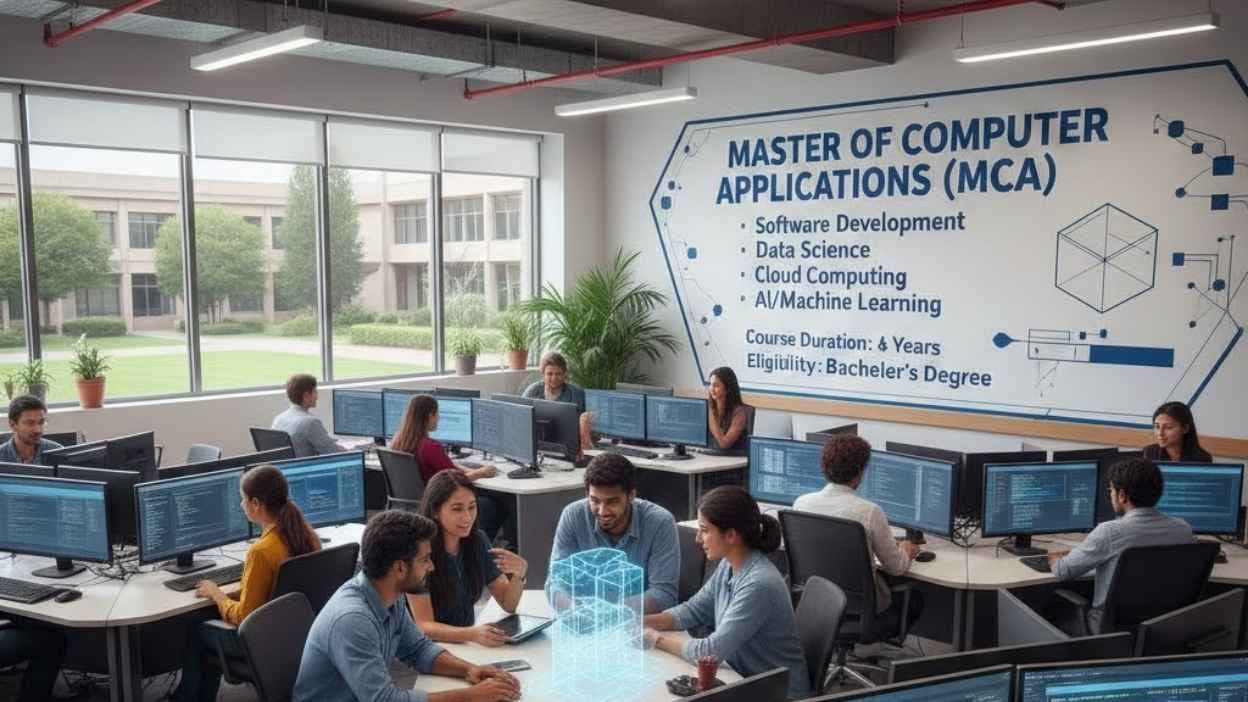
Flexible Duration: While historically a three-year program, most Indian universities have shifted to a high-intensity two-year (four-semester) format to meet the urgent industry demand.
Diverse Entry Points: It is accessible to graduates from BCA, B.Sc. (CS/IT), and even B.Com or BA backgrounds, provided they have a foundation in mathematics.
2. The Artificial Intelligence Gateway: Why Everyone is Watching
The primary reason "What is MCA course" is trending in 2026 is its role as the premier training ground for AI specialists. We have entered the "Cognitive Orchestration" era, where monolithic models are being replaced by multi-layered architectures that coordinate specialized agents.
The demand for AI talent in India is expected to cross one million roles by the end of 2026, yet the country faces a significant skill deficit. The MCA course has evolved to fill this "AI talent race" by offering specialized tracks in:
Agentic AI & ML: Training students to design autonomous agents that can plan, execute, and adapt workflows without constant human oversight.
Natural Language Processing (NLP): Enabling machines to understand human context, which is critical for the "Answer Economy" that is currently replacing traditional search.
Multimodal Reasoning: Teaching systems to process text, images, and audio simultaneously a skill that achieves 40% higher accuracy in complex tasks compared to single-modal models..
3. The 2026 Infrastructure Shift: MCA Graduates as Orchestrators
In 2026, the architecture of AI applications has stabilized into a consistent three-layer stack: the Model Layer, the Tool Layer, and the Orchestration Layer. Everyone needs to know what an MCA course is because its graduates are the "conductors" of this central nervous system.
Why the Orchestration Layer Matters to Everyone:
Systemic Reliability: MCA professionals ensure that AI queries are routed to the most efficient model, slash operational costs, and reduce the "cognitive load" on systems.
Retrieval-First Logic (RAG): By separating "Compute" (the model) from "Memory" (the vector store), MCA experts transform generative problems into reliable retrieval systems, effectively ending the era of AI hallucinations.
Tool Integration: Graduates learn to use the Model Context Protocol (MCP) to plug specialized services like payroll, CRM, or medical databases—directly into AI assistants.
4. Vertical Breakthroughs: From Coding to Curing
Knowledge of the MCA course is vital because its impact has transcended the "tech" sector. By 2026, every industry from healthcare to agriculture is a software industry.
Biotechnology: MCA experts are now using Protein Language Models to solve the "Inverse Design" problem, proposing novel molecular structures for drugs that were previously "undruggable."
BFSI (Banking & Finance): The financial sector is the most exploited by cybercriminals, with over 1.3 million incidents reported recently. MCA graduates specializing in Cybersecurity are the primary line of defense.
Green AI: As data centers project to consume 1,050 TWh by late 2026, MCA curriculum now emphasizes "Energy-to-Solution" metrics, teaching students to shrink models via knowledge distillation to reduce carbon footprints.
5. The Economic Reality: Salaries and ROI in 2026
For many, the interest in "What is MCA course" is purely financial. The field is known for rewarding skill and practical exposure generously. As digital transformation accelerates, the salary gap between generalist graduates and MCA specialists has widened.
2026 Salary Benchmarks for MCA Graduates in India:
Entry-Level (0–2 years): Graduates typically start between ₹4 LPA and ₹12 LPA. Top product-based firms (Google, Amazon) offer much higher initial packages for those who pass rigorous coding tests.
Mid-Level (3–6 years): Professionals in specialized roles like Cloud Architects or AI Engineers command between ₹12 LPA and ₹25 LPA.
Senior Leadership (10+ years): Experts such as Staff Security Engineers or Principal Architects can earn between ₹35 LPA and ₹90 LPA, rivaling executive management salaries.
This high ROI is further bolstered by the affordability of the degree. Government institutes offer MCA programs for as little as ₹30,000 to ₹1 lakh, making the "payback period" on the educational investment exceptionally short compared to other master's degrees.
6. The Skills-First Revolution: Online and Hybrid Learning
By 2026, the mode of education has become secondary to the validation of competencies. The "Skills-First Revolution" means that 92% of employers now prioritize validated skills over formal degrees. This shift has made Online MCA programs from UGC-approved universities just as valuable as their on-campus counterparts.
The 2026 Online MCA Experience:
Virtual Labs: Students practice in cloud-based environments that mimic real-world enterprise infrastructure.
Industry Integration: Curriculums are designed with input from tech giants, including live projects and mandatory internships that often lead to pre-placement offers.
AI-Based Personalization: Learning platforms now use AI to create personalized study plans for students, allowing them to balance work and education seamlessly.
7. The Regulatory Mandate: Navigating the DPDP Act
Finally, everyone needs to know what is MCA course because of the legal landscape. The full enforcement of India’s Digital Personal Data Protection (DPDP) Act in 2026 has turned data privacy into a business survival strategy.
Companies face penalties of up to ₹250 crore for data violations. Consequently, there is an urgent demand for MCA graduates who understand:
Privacy by Design: Integrating security controls into the very architecture of products.
Mandatory Breach Reporting: Managing digital forensics and incident response to notify authorities within legal timelines.
Consent Management: Implementing revokable consent architectures that ensure user rights are respected in automated systems.
Conclusion: Why Knowledge is Strategic Power
In the year 2026, the transition from "discovery" to "deployment" in the tech world is complete. The organizations and individuals who succeed are not those who have the most powerful general models, but those who have the most robust orchestration layers and the strongest data foundations.
The MCA course is the engine room of this transition. Whether you are a student mapping your future, a professional looking to upskill, or a leader trying to secure your digital assets, knowing "What is MCA course" provides the roadmap to 2026 and beyond. As automation becomes more powerful, the need for skilled human orchestrators to define the "why" behind the technology has never been more critical.
Frequently Asked Questions (FAQs)
Why Everyone in 2026 Needs to Know What is MCA Course?
The technological landscape of 2026 represents a definitive maturation of artificial intelligence from a phase of speculative experimentation into a disciplined era of operational orchestration. In this new reality, the question "What is MCA course?" is no longer confined to academic circles. It has become a central topic of conversation for professionals, students, and industry leaders alike. As organizations move beyond the initial excitement of large language models, the focus has shifted toward systemic reliability and agentic autonomy, making the Master of Computer Applications (MCA) the strategic gateway to the 2026 digital economy.
By 2026, India’s IT sector is projected to employ over 10 million professionals, with a massive surge in demand for specialized experts who can bridge the gap between theoretical computer science and practical application. This report explores why understanding the MCA course is now a non-negotiable requirement for navigating the future of work.
1. Defining the 2026 MCA: More Than Just a Degree
To understand why everyone is talking about it, we must first define the modern iteration of the program. Master of Computer Applications (MCA) is a professional postgraduate degree designed to create "digital orchestrators." While a Bachelor's degree provides the foundation, the MCA in 2026 offers a deep dive into the architectures powering our world.
Core Characteristics of the 2026 MCA Course:
Application-Oriented Curriculum: Unlike theoretical research degrees, the MCA focuses on creating software, managing databases, and designing intelligent systems that solve real-world problems.
Flexible Duration: While historically a three-year program, most Indian universities have shifted to a high-intensity two-year (four-semester) format to meet the urgent industry demand.
Diverse Entry Points: It is accessible to graduates from BCA, B.Sc. (CS/IT), and even B.Com or BA backgrounds, provided they have a foundation in mathematics.
2. The Artificial Intelligence Gateway: Why Everyone is Watching
The primary reason "What is MCA course" is trending in 2026 is its role as the premier training ground for AI specialists. We have entered the "Cognitive Orchestration" era, where monolithic models are being replaced by multi-layered architectures that coordinate specialized agents.
The demand for AI talent in India is expected to cross one million roles by the end of 2026, yet the country faces a significant skill deficit. The MCA course has evolved to fill this "AI talent race" by offering specialized tracks in:
Agentic AI & ML: Training students to design autonomous agents that can plan, execute, and adapt workflows without constant human oversight.
Natural Language Processing (NLP): Enabling machines to understand human context, which is critical for the "Answer Economy" that is currently replacing traditional search.
Multimodal Reasoning: Teaching systems to process text, images, and audio simultaneously—a skill that achieves 40% higher accuracy in complex tasks compared to single-modal models.
3. The 2026 Infrastructure Shift: MCA Graduates as Orchestrators
In 2026, the architecture of AI applications has stabilized into a consistent three-layer stack: the Model Layer, the Tool Layer, and the Orchestration Layer. Everyone needs to know what an MCA course is because its graduates are the "conductors" of this central nervous system.
Why the Orchestration Layer Matters to Everyone:
Systemic Reliability: MCA professionals ensure that AI queries are routed to the most efficient model, slash operational costs, and reduce the "cognitive load" on systems.
Retrieval-First Logic (RAG): By separating "Compute" (the model) from "Memory" (the vector store), MCA experts transform generative problems into reliable retrieval systems, effectively ending the era of AI hallucinations.
Tool Integration: Graduates learn to use the Model Context Protocol (MCP) to plug specialized services—like payroll, CRM, or medical databases—directly into AI assistants.
4. Vertical Breakthroughs: From Coding to Curing
Knowledge of the MCA course is vital because its impact has transcended the "tech" sector. By 2026, every industry—from healthcare to agriculture—is a software industry.
Biotechnology: MCA experts are now using Protein Language Models to solve the "Inverse Design" problem, proposing novel molecular structures for drugs that were previously "undruggable."
BFSI (Banking & Finance): The financial sector is the most exploited by cybercriminals, with over 1.3 million incidents reported recently. MCA graduates specializing in Cybersecurity are the primary line of defense.
Green AI: As data centers project to consume 1,050 TWh by late 2026, MCA curriculum now emphasizes "Energy-to-Solution" metrics, teaching students to shrink models via knowledge distillation to reduce carbon footprints.
5. The Economic Reality: Salaries and ROI in 2026
For many, the interest in "What is MCA course" is purely financial. The field is known for rewarding skill and practical exposure generously. As digital transformation accelerates, the salary gap between generalist graduates and MCA specialists has widened.
2026 Salary Benchmarks for MCA Graduates in India:
Entry-Level (0–2 years): Graduates typically start between ₹4 LPA and ₹12 LPA. Top product-based firms (Google, Amazon) offer much higher initial packages for those who pass rigorous coding tests.
Mid-Level (3–6 years): Professionals in specialized roles like Cloud Architects or AI Engineers command between ₹12 LPA and ₹25 LPA.
Senior Leadership (10+ years): Experts such as Staff Security Engineers or Principal Architects can earn between ₹35 LPA and ₹90 LPA, rivaling executive management salaries.
This high ROI is further bolstered by the affordability of the degree. Government institutes offer MCA programs for as little as ₹30,000 to ₹1 lakh, making the "payback period" on the educational investment exceptionally short compared to other master's degrees.
6. The Skills-First Revolution: Online and Hybrid Learning
By 2026, the mode of education has become secondary to the validation of competencies. The "Skills-First Revolution" means that 92% of employers now prioritize validated skills over formal degrees. This shift has made Online MCA programs from UGC-approved universities just as valuable as their on-campus counterparts.
The 2026 Online MCA Experience:
Virtual Labs: Students practice in cloud-based environments that mimic real-world enterprise infrastructure.
Industry Integration: Curriculums are designed with input from tech giants, including live projects and mandatory internships that often lead to pre-placement offers.
AI-Based Personalization: Learning platforms now use AI to create personalized study plans for students, allowing them to balance work and education seamlessly.
7. The Regulatory Mandate: Navigating the DPDP Act
Finally, everyone needs to know what is MCA course because of the legal landscape. The full enforcement of India’s Digital Personal Data Protection (DPDP) Act in 2026 has turned data privacy into a business survival strategy.
Companies face penalties of up to ₹250 crore for data violations. Consequently, there is an urgent demand for MCA graduates who understand:
Privacy by Design: Integrating security controls into the very architecture of products.
Mandatory Breach Reporting: Managing digital forensics and incident response to notify authorities within legal timelines.
Consent Management: Implementing revokable consent architectures that ensure user rights are respected in automated systems.
Conclusion: Why Knowledge is Strategic Power
In the year 2026, the transition from "discovery" to "deployment" in the tech world is complete. The organizations and individuals who succeed are not those who have the most powerful general models, but those who have the most robust orchestration layers and the strongest data foundations.
The MCA course is the engine room of this transition. Whether you are a student mapping your future, a professional looking to upskill, or a leader trying to secure your digital assets, knowing "What is MCA course" provides the roadmap to 2026 and beyond. As automation becomes more powerful, the need for skilled human orchestrators to define the "why" behind the technology has never been more critical.
Frequently Asked Questions (FAQs)
1. What is the MCA course full form and duration in 2026?
MCA stands for Master of Computer Applications. In 2026, most Indian universities offer a high-intensity 2-year (4-semester) program to meet rapid industry demand for technical specialists.
2. Can I pursue an MCA after a non-technical graduation?
Yes. Graduates from fields like B.Com or BA are eligible if they had Mathematics in 12th grade or graduation, though some universities require additional "bridge courses."
3. Why is the MCA course considered "recession-proof" in 2026?
As industries like healthcare, finance, and manufacturing digitize, the demand for "digital guardians" and AI orchestrators remains constant, even during economic shifts, ensuring long-term job stability.
4. What are the highest-paying specializations in MCA today?
AI/ML Engineering, Cloud Architecture, and Cybersecurity are the most lucrative. Experts in these fields can command salaries ranging from ₹20 LPA to over ₹90 LPA depending on experience.
5. Is an online MCA valid for government jobs in 2026?
Yes. UGC-approved online degrees are treated on par with regular degrees for employment in both the private and public sectors, including PSU and government roles.
6. How does the DPDP Act affect MCA career opportunities?
The Act mandates strict data privacy, creating thousands of roles for Data Protection Officers and compliance analysts. MCA graduates are uniquely qualified to design these "privacy-first" architectures.
7. What is the difference between MCA and M.Tech in 2026?
MCA is application-oriented and focuses on software development and IT management. M.Tech is more research-intensive, focusing on engineering principles and deep technical innovation for academic or R&D roles.
Continue Learning
Explore more insights and tutorials to enhance your skills