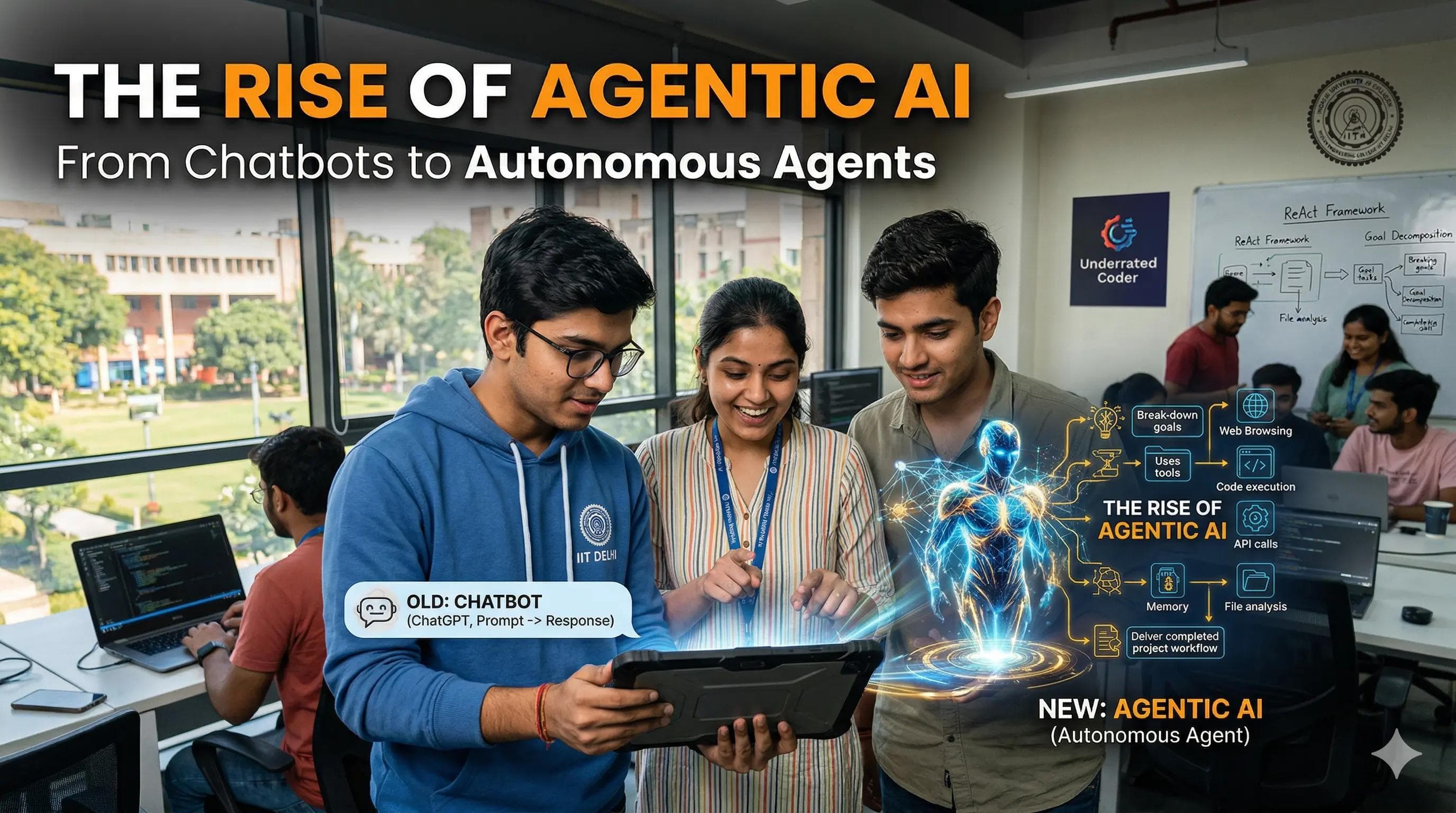
The Rise of Agentic AI: Moving Beyond Chatbots to Autonomous Agents | Underrated Coder
The Rise of Agentic AI: Moving Beyond Chatbots to Autonomous Agents
40 min read
Share:
For the last few years, the tech industry has been entirely captivated by Generative AI. We type a prompt, and a Large Language Model (LLM) instantly generates code, writes an essay, or creates an image. It is incredibly powerful, but it comes with a major limitation: it requires constant human hand-holding. Every new step requires a new prompt.
But the industry is currently experiencing a massive paradigm shift. The next big frontier isn't just artificial intelligence that talks; it’s AI that acts.
Welcome to the era of Agentic AI.
For developers, tech enthusiasts, and computer science students looking to stay ahead of the curve, understanding how autonomous AI agents work is no longer optional—it is the new baseline. In this comprehensive guide, we will break down exactly what Agentic AI is, how it differs from traditional chatbots, the underlying architecture, and how you can start building your own autonomous systems.
🧠 What Exactly is Agentic AI?
Agentic AI refers to artificial intelligence systems designed to pursue complex, multi-step goals with limited to no direct human supervision. Instead of just answering a single, isolated query, an "AI Agent" can break down a large objective into smaller tasks, browse the live web, execute code, correct its own errors, and continuously work until the objective is completed.
Think of the evolution this way:
Generative AI (The Assistant): You ask for a Python script to scrape a website. It writes the code for you to copy, paste, debug, and run.
Agentic AI (The Employee): You tell the AI, "Scrape this website, analyze the data for market trends, and email me a formatted PDF report." The agent writes the code, sets up the virtual environment, runs the script, handles any server errors, formats the PDF, and sends the email without you lifting another finger.
⚙️ The Core Architecture: How Do AI Agents Work?
To understand why Agentic AI is so revolutionary, you have to look under the hood. Unlike a standard chatbot interface, an AI agent relies on four foundational pillars to operate autonomously.
1. The "Brain" (Large Language Models)
The core reasoning engine of an AI agent is still an LLM (like GPT-4, Claude 3, or Llama). However, instead of just generating text for a human to read, the LLM is used to process information, make decisions, and route tasks.
2. Planning and Reasoning (ReAct Framework)
Before an agent takes action, it must plan. Modern agents use frameworks like ReAct (Reasoning and Acting). They literally "think" out loud. The agent looks at the overarching goal, creates a step-by-step to-do list, evaluates its progress after each step, and pivots if a strategy isn't working.
3. Memory Systems
Standard chatbots have a very short context window—they forget what you said earlier in the conversation. Agentic AI utilizes robust memory:
Short-term memory: Keeping track of the immediate task at hand.
Long-term memory: Utilizing vector databases (like Pinecone or Milvus) to store and recall information from past tasks, user preferences, or massive company datasets over time.
4. Tools and Actuators
This is the game-changer. An LLM in isolation is trapped in a box. AI agents are given access to external tools via APIs. They can execute terminal commands, query SQL databases, search Google, read GitHub repositories, and post to social media.
⚡ Generative AI vs. Agentic AI: The Key Differences
If you are a developer entering the AI space, understanding this distinction is crucial for building modern applications.
Feature
Generative AI (Chatbots)
Agentic AI (Autonomous Agents)
Trigger
Reactive (Waits for user prompts)
Proactive (Executes a chain of tasks autonomously)
Output
Text, code, or images
Completed actions and real-world workflows
Scope
Single-turn conversations
Multi-step, complex objectives over long periods
Error Handling
Requires human to spot and correct errors
Self-reflects, debugs its own code, and tries new approaches
Tool Integration
Limited (mostly internal retrieval)
Extensive (Web browsers, APIs, IDEs, databases)
💼 Real-World Use Cases: Why the Industry is Shifting
The tech world isn't just building agents for fun; they are solving massive operational bottlenecks.
1. Autonomous Software Engineering
Tools like Devin or Auto-GPT are acting as junior developers. You can give an agent an issue from a GitHub repository, and it will clone the repo, read the documentation, find the bug, write the patch, test it, and submit a pull request.
2. Marketing and Research
Instead of a human spending ten hours researching competitors, an agent can scrape competitor websites, analyze their SEO strategies, cross-reference pricing models, and generate a comprehensive strategy document in minutes.
3. Customer Success
Next-generation customer service agents don't just point users to FAQ articles. If a customer asks for a refund, the agentic AI can verify the purchase in Stripe, check the company's return policy, process the refund, and update the CRM—all autonomously.
🛠️ Multi-Agent Systems: The Future of Work
The most exciting development right now is Multi-Agent Orchestration. Why have one AI agent do everything when you can have a whole team of specialized agents working together?
Using frameworks like CrewAI or Microsoft AutoGen, developers are building digital agencies. You can create:
A "Researcher Agent" that gathers data.
A "Writer Agent" that drafts the content.
A "QA Agent" that reviews the code or text for errors.
They communicate with each other, pass data back and forth, and deliver a polished final product.
🗺️ How Developers Can Start Building Agentic AI
The tech industry is moving incredibly fast. Companies are no longer just looking for developers who can integrate a simple ChatGPT wrapper into a web app. They are actively hunting for engineers who understand how to build autonomous systems, orchestrate multi-agent frameworks, and deploy open-source models locally.
If you are a college student or an aspiring developer, mastering AI and Machine Learning is the ultimate cheat code to securing top-tier internships, winning hackathons, and future-proofing your career. But with so much noise and thousands of tutorials on the internet, figuring out where to start can be overwhelming.
You need to master Python, understand neural networks, learn how LLMs function, and get hands-on with AI frameworks.
To help you cut through the noise, we have put together the definitive guide for mastering this tech stack. Stop guessing what to learn next and follow a proven, structured path. Check out the complete, step-by-step AI & ML Roadmap by Underrated Coder. It covers everything from the absolute basics to advanced model deployment, designed specifically for developers who want to build real-world projects.
❓ Frequently Asked Questions (FAQ)
Is Agentic AI dangerous?
Like any powerful technology, it carries risks, primarily related to data security and unpredictable behavior (hallucinations) when taking actions. This is why "human-in-the-loop" (HITL) safeguards are currently built into most enterprise agentic systems.
What programming language is best for building AI agents?
Python is the undisputed king of AI development. The vast majority of agentic frameworks, including LangChain, CrewAI, and AutoGen, are built primarily for Python.
Will AI agents replace software developers?
AI agents will not replace developers; they will replace developers who don't use AI. Agents are excellent at handling boilerplate code, writing tests, and finding syntax errors, freeing up human engineers to focus on complex system architecture and high-level problem-solving.
🏁 Final Thoughts
Agentic AI is not just a passing buzzword; it is the next evolution of software engineering. We are moving from digital tools that we operate to digital entities that we manage. The developers who learn how to harness, build, and deploy AI agents today will be the ones leading the tech industry tomorrow.
Don't just watch the AI revolution happen—start building it.
Continue Learning
Explore more insights and tutorials to enhance your skills