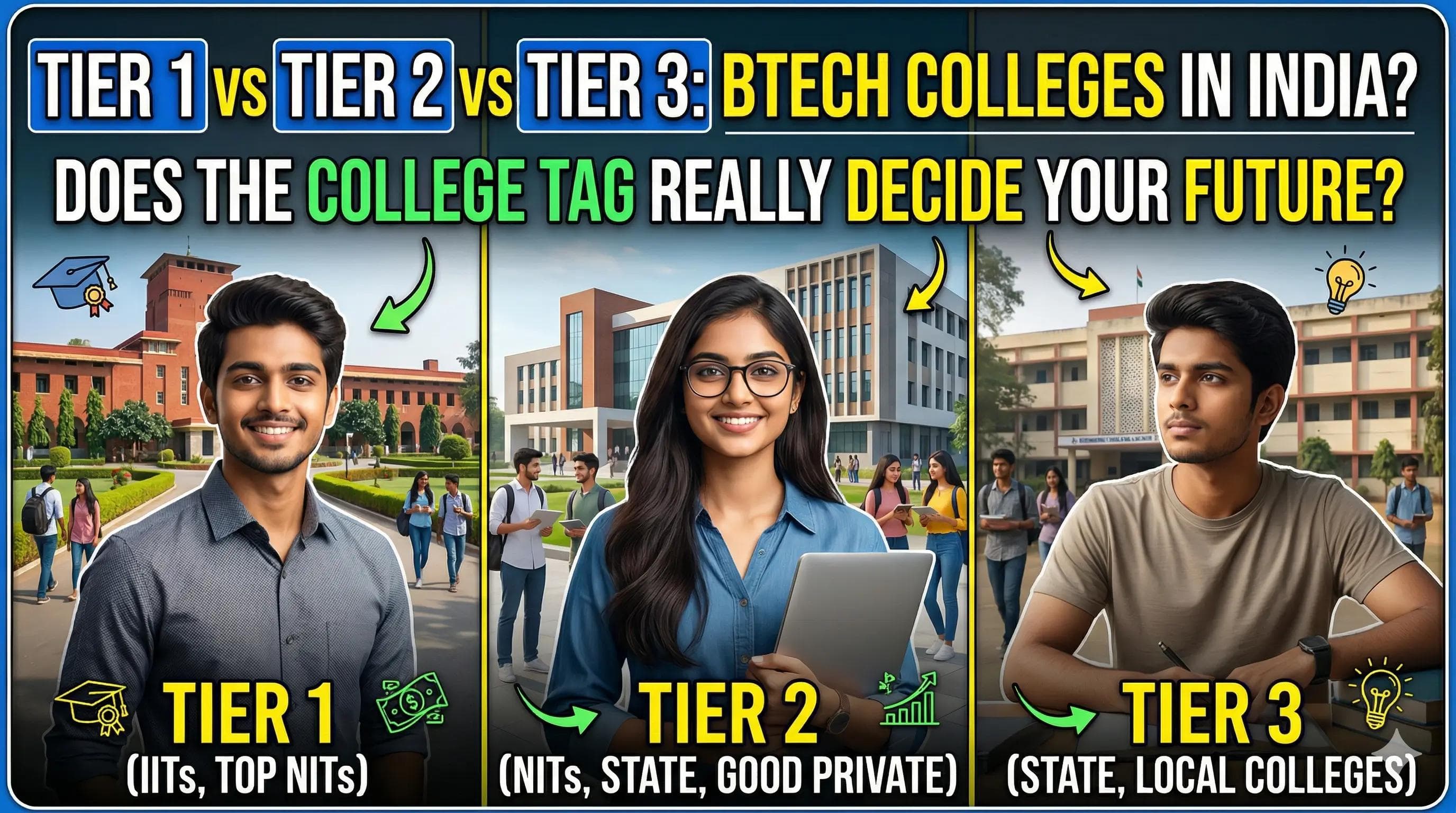
Let’s address the elephant in the room. You’ve spent the last two years burning the midnight oil for JEE, and now the results are out. You are staring at your rank, desperately googling Tier 1 vs Tier 2 vs Tier 3 colleges for BTech, and wondering if your career is over before it even started.
Take a deep breath. The anxiety you are feeling is completely normal, but the narrative you’ve been sold is fundamentally flawed. Society loves to categorize students by their college tags, making it seem like a Tier 1 admission is a guaranteed golden ticket and a Tier 3 admission is a life sentence to mediocrity.
Here is the reality check from Underrated Coder: Your college tag might get you your very first interview, but pure, unadulterated hustle and raw skills will build your actual career. Let’s break down the real difference between these tiers and show you how to beat the system, no matter where you enroll.
The Breakdown: What Do the Tiers Actually Mean?
Understanding the landscape is the first step to conquering it. Here is the unfiltered breakdown of what each tier actually offers.
Tier 1 Colleges: The Prestige and The Pressure
These are the heavyweights—the old IITs, top NITs, IIIT Hyderabad, and BITS Pilani.
- The Pros: You get access to a brilliant alumni network, massive funding, and top-tier product-based companies visiting for on-campus BTech placements. The starting packages are often the ones making newspaper headlines.
- The Reality: It is fiercely competitive. You are surrounded by the top 1% of brains in the country, which often leads to brutal imposter syndrome. Just walking through the gates doesn't guarantee a 50 LPA package; you still have to out-code geniuses to get it.
Tier 2 Colleges: The Middle Ground
This category includes the newer NITs, newer IIITs, and top-ranking state or private universities (like VIT, Manipal, or Thapar).
- The Pros: These colleges offer a solid balance. You get decent infrastructure, a competitive peer group, and visits from a mix of product-based companies and high-paying service companies.
- The Reality: The spoon-feeding stops here. While the opportunities exist, you cannot rely entirely on the college placement cell. To land top-tier software engineering jobs, you have to take massive personal initiative to upskill beyond the outdated university curriculum.
Tier 3 Colleges: The Underdog Arena
These are your local engineering colleges, newer private institutes, and state colleges with lenient admission criteria.
- The Cons (Brutal Honesty): The coding culture is often non-existent. On-campus placements are heavily dominated by mass recruiters offering 3-4 LPA packages, and the faculty might still be teaching you tech stacks from 2010.
- The Solution: You have the ultimate cheat code—the internet. The lack of on-campus pressure means you have the free time to build a phenomenal portfolio. With open-source contributions and a relentless focus on off-campus opportunities, you can entirely bypass the limitations of your campus.
The Ultimate Equalizer: Skills > College Tags
If you want to know the real difference between Tier 1 and Tier 3 colleges, it’s simply the starting line. But a B.Tech is a four-year marathon, and the tech industry is rapidly changing its rules. Companies care less about the logo on your degree and more about the code in your repositories.
The industry is becoming ruthlessly skill-centric. A Tier 3 student armed with an exceptional GitHub portfolio, an iron-clad grasp of Data Structures and Algorithms (DSA), and production-level development skills is a lethal competitor. When you apply for off-campus placements, the recruiter’s automated resume screener doesn't reject you for your college; it rejects you if you lack the right tech stack.
You can absolutely beat a Tier 1 student in a technical interview if your coding skills for BTech are sharper. It happens every single day. The "Underrated" philosophy is simple: Out-work, out-build, and out-code the competition until your college tag becomes completely irrelevant.
Your Actionable Level-Up Roadmap
If you are sitting in a lower-tier college feeling lost, stop complaining and start executing. Here is your 3-step checklist to level the playing field:
- Master the Fundamentals: Pick one language (C++, Java, or Python) and master it. Grind Data Structures and Algorithms until your logic is bulletproof. This is your foundation for clearing technical screening rounds.
- Build Proof of Work: Stop making generic "To-Do" apps. Build real, complex projects using modern stacks (MERN, Web3, or AI integration). Deploy them, document them, and make your GitHub commit graph glow green.
- Network Like a Maniac: Your college won't bring the companies to you, so you must go to them. Build a personal brand on LinkedIn and Twitter. Cold email recruiters, participate in open-source hackathons, and connect with engineers at your dream companies.
Stop Worrying, Start Coding
The anxiety over Tier 1 vs Tier 2 vs Tier 3 colleges for BTech ends today. You are now the CEO of your own career. You can either spend the next four years complaining about your college's lack of infrastructure, or you can open your laptop and start building the future you actually deserve.
It’s time to stop feeling underrated and start acting unstoppable.
Ready to outwork the competition? Join the exclusive Underrated Coder WhatsApp Community today. We drop premium coding resources, off-campus hackathon updates, and step-by-step career roadmaps directly to your phone. Plus, check out our targeted upskilling courses—they are specifically designed to bridge the gap between Tier 3 classrooms and Tier 1 tech jobs. Stop waiting for permission. Let's code.
Frequently Asked Questions (FAQs)
1. Is it really possible to get a job at a product-based company from a Tier 3 college? Yes, absolutely. While Tier 1 colleges have companies visit their campus directly, Tier 3 students can secure the exact same roles through off-campus placements. Companies like Amazon, Google, and Microsoft regularly hire off-campus based on your Data Structures and Algorithms (DSA) skills and personal projects, not your college name.
2. What is the biggest difference between a Tier 1 and a Tier 3 engineering college? The main differences are the alumni network, peer group, and on-campus placement opportunities. Tier 1 colleges offer heavy on-campus recruitment from top tech giants, whereas Tier 3 colleges are usually visited by mass recruiters. However, the syllabus is mostly the same, meaning your personal upskilling dictates your future.
3. How can a Tier 2 or Tier 3 B.Tech student compete with a Tier 1 student? By building a stronger portfolio. To beat the college tag, you need to master a programming language, build complex, real-world projects, contribute to open-source, and aggressively network on platforms like LinkedIn and Twitter to land off-campus referrals.
4. Do companies filter out resumes based on college tiers during off-campus hiring? Modern tech companies rely on Applicant Tracking Systems (ATS) that filter resumes based on skills, keywords, and experience, not just the college name. If your resume highlights modern tech stacks, strong GitHub contributions, and hackathon wins, you will bypass the college filter.
5. Are off-campus placements much harder to crack than on-campus ones? They require more independent hustle. On-campus placements are served to you, while off-campus placements require you to actively hunt for openings, cold-email recruiters, and take technical assessments independently. The interviews themselves, however, test the exact same coding competencies.
6. Which programming language should I learn first to secure a high-paying job? If your goal is to master Data Structures and Algorithms for coding interviews, C++ or Java are the industry standards. If you want to dive straight into development and startups, JavaScript (along with frameworks like React and Node.js) or Python are excellent choices.
7. Can upskilling courses actually bridge the gap between Tier 3 and Tier 1? Yes. Traditional college curriculums are often outdated. Targeted upskilling courses, like those offered by the Underrated Coder community, focus entirely on what the industry actually demands today—advanced DSA, modern web development, and interview preparation—saving you years of trial and error.