How to Win a Hackathon: Complete Step-by-Step Roadmap (2026 Guide) | Underrated Coder
How to Win a Hackathon: Complete Step-by-Step Roadmap (2026 Guide)
25 min read
Share:
Hackathons have become the ultimate launchpad for college students, developers, and designers to showcase their skills, build impactful solutions, and even land startup funding. But whether you are a first-year student or an experienced coder, winning a hackathon takes much more than just writing flawless code. It requires strategy, execution, and storytelling.
Through Underrated Coder, we’ve mentored countless students, and having recently sat on the other side of the table as a hackathon judge at Bennett University, the reality is clear: the smartest builders beat the best coders almost every time.
In this complete roadmap, you will learn the step-by-step strategy that top-performing teams use to take home the prize.
🧠 What Actually Makes a Winning Hackathon Project?
A hackathon is a time-bound innovation marathon, usually lasting 24 to 72 hours. While domains range from AI and Web3 to Healthcare and FinTech, the judging criteria rarely change.
Winning requires a careful balance of:
Technical Execution: Does the core feature actually work?
Problem-Solving: Is this a real-world problem, or a made-up one?
Creativity: Are you using modern tools (like AI) in a unique way?
The Pitch: Can you explain your impact in 3 minutes?
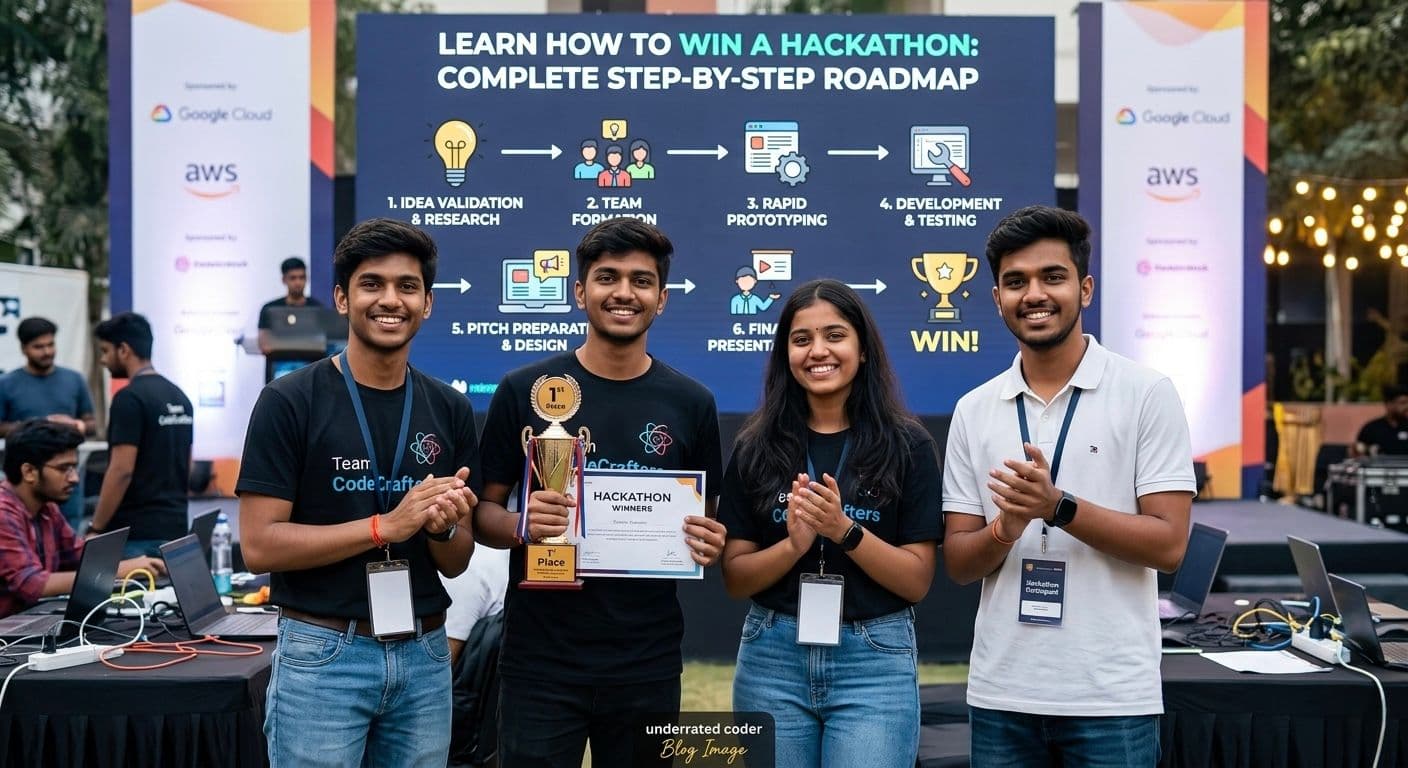
🏆 The Step-by-Step Hackathon Roadmap to Win
1. Choose the Right Hackathon for Your Skill Level
Not all hackathons are created equal. If you are just starting out, diving into a highly competitive, global AI hackathon might be overwhelming.
Analyze the Theme: Ensure it aligns with your tech stack (e.g., Open Innovation, EdTech, Blockchain).
Review Past Winners: Look at the repositories of past winning projects to gauge the expected level of polish.
Start Local: Beginner-friendly or university-level hackathons are the best places to build confidence and test your workflow.
2. Assemble a Balanced, Cross-Functional Team
A common mistake is forming a team of five backend developers. A winning team needs a mix of skills.
The ideal hackathon team structure:
1 Frontend Developer: To make it look incredible.
1 Backend/AI Developer: To handle the core logic and database.
1 UI/UX Designer: To map out the user journey.
1 Strategist/Presenter: To focus on the business model and pitch.
3. Target a Unique, High-Impact Problem Statement
Most teams fail before they even open their code editor because they choose a generic idea (like another to-do app). Judges are looking for impact.
Find Real Pain Points: Look for inefficiencies in campus life, local businesses, or emerging tech.
Add an Innovative Twist: How can you apply automation, data analytics, or AI to solve an old problem in a new way?
4. The 3-Hour Validation & Planning Phase
Do not write a single line of code until you have validated the idea. Break your hackathon timeline down efficiently:
First 15% of time: Idea validation, checking existing solutions, and defining the target user.
Next 65% of time: Heads-down development and building the MVP.
Final 20% of time: Bug testing, refining the UI, and practicing the presentation.
5. Stick to a Fast, Reliable Tech Stack
A hackathon is not the time to learn a new framework from scratch. Speed is your biggest asset.
Recommended Tech Stack for Rapid Development:
Frontend: Next.js or React (paired with Tailwind CSS or ShadCN for fast styling).
Backend: Node.js, Firebase, or Supabase.
AI Integrations: OpenAI API or Hugging Face.
6. Build the MVP (Minimum Viable Product), Not the Whole App
Judges prefer a simple product with three features that work perfectly over a massive platform where nothing works. Focus entirely on the core functionality that solves your specific problem statement.
7. Prioritize UI/UX (First Impressions Matter)
Design is often the tie-breaker. Judges have to review dozens of projects, and a clean, intuitive interface immediately signals professionalism. Keep navigation simple and ensure your typography and colors are consistent.
8. Master the 3-Minute Pitch
This is where winners are decided. You can have the best code in the room, but if you can't sell the vision, you won't win.
Your pitch structure must include:
The Hook: What is the urgent problem?
The Solution: A quick, live demo of your working product.
The Differentiator: Why your tech stack or approach is unique.
The Future: How this could scale into a real startup.
❌ Common Hackathon Mistakes to Avoid
"Feature Creep": Trying to build too many things and running out of time.
Live Demo Disasters: Always have a pre-recorded video of your working app just in case the WiFi drops or an API fails during judging.
Ignoring the Business Case: Code without a use case is just a repository. Ensure you know who will use your app.
🏁 Final Thoughts for College Coders
Winning a hackathon isn’t just about the prize money; it’s about the network you build, the GitHub commits you make, and the experience of building under pressure. Stay focused, execute your MVP, and remember to tell a great story.
Continue Learning
Explore more insights and tutorials to enhance your skills