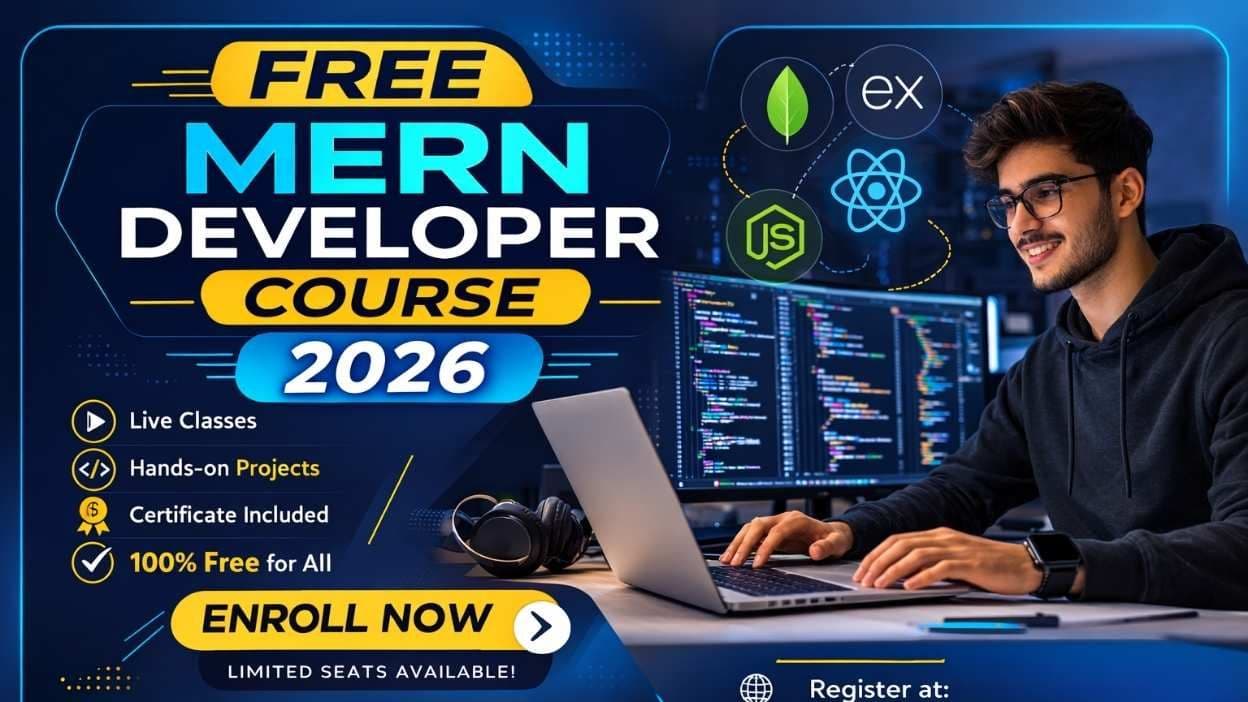
In 2026, the landscape of web development is shifting toward high-performance, AI-integrated, and highly scalable applications. The MERN stack (MongoDB, Express.js, React, and Node.js) remains the undisputed champion for developers who want to build full-stack JavaScript applications. This Free MERN Developer Course 2026: Modern React 19 & Node Mastery guide is designed to take you from a basic understanding of code to becoming a professional engineer capable of building production-grade software.
As we navigate through 2026, simply knowing how to build a basic website is not enough. You must understand how to integrate "Agentic AI," handle real-time data streams, and utilize the latest features of React 19 and Node.js 24. This article serves as your comprehensive roadmap to mastering full-stack development without spending a single penny on expensive bootcamps.
The Evolution of MERN in 2026
The MERN stack has matured significantly. In 2026, the stack is no longer just a collection of four libraries; it is an ecosystem. With React 19 introducing groundbreaking features like Server Components and Compiler-driven optimization, the gap between the frontend and backend has narrowed.
MongoDB Atlas: Now features integrated Vector Search, allowing MERN developers to build AI recommendation engines directly within their database.
Express.js 5.0: The stable release of Express 5 has brought better error handling and native promise support, making your backend code cleaner.
React 19 Mastery: The focus has shifted toward "Zero-bundle size" components and the use of the use API for data fetching.
Node.js Mastery: With the integration of native TypeScript support in Node.js, developers can now write type-safe backend code without complex build tools.
Phase 1: Foundations of Full-Stack JavaScript
Before diving into the stack, a professional Free MERN Developer Course 2026 must emphasize the core language: JavaScript. In 2026, you aren't just writing scripts; you are building complex systems.
Modern JavaScript (ESNext): You must master Optional Chaining, Nullish Coalescing, and the latest Array methods.
Asynchronous Programming: Mastery of async/await and understanding the Event Loop is non-negotiable for Node.js mastery.
TypeScript Integration: Most high-paying MERN jobs in 2026 require TypeScript. It is essential to learn how to define interfaces and types for your MongoDB schemas and React props.
Phase 2: Master React 19 (The Frontend Powerhouse)
React 19 is the star of the show in this Free MERN Developer Course 2026. It has completely changed how we think about the "View" layer.
React Server Components (RSC): Learn how to render components on the server to reduce the JavaScript sent to the client. This is a game-changer for SEO and performance.
The React Compiler: Understand how the new compiler automatically memoizes your components, eliminating the need for useMemo and useCallback in most cases.
New Hooks & Actions: Master the useActionState and useFormStatus hooks, which simplify form handling and state management without external libraries like Redux for simple tasks.
State Management: While Redux Toolkit is still relevant, in 2026, many developers are moving toward Zustand or TanStack Query for more efficient server-state management.
Phase 3: Mastering Node.js & Express.js (The Backend Brain)
A Free MERN Developer Course 2026 is incomplete without deep Node mastery. Node.js is now faster and more secure than ever.
RESTful vs. GraphQL: While REST is standard, learning how to build a GraphQL API with Apollo Server is a highly valued skill in 2026.
Security Best Practices: You will learn how to implement Rate Limiting, Helmet.js for header security, and advanced JWT (JSON Web Token) rotation strategies.
Real-time Communication: In 2026, every app is interactive. Mastering Socket.io for real-time chat, notifications, and live tracking is a core requirement of this course.
Microservices vs. Monoliths: Understand when to build a single backend and when to split your Node.js services into microservices using Docker.
Phase 4: Database Excellence with MongoDB
In a Free MERN Developer Course 2026, we don't just store data; we optimize it. MongoDB has evolved to be the primary choice for AI-driven applications.
Mongoose Modeling: Learn advanced schema design, including virtuals, statics, and pre/post-save hooks.
Aggregation Framework: This is where the real power lies. Master the pipeline to filter, group, and transform data before it even reaches your Node.js server.
Atlas Vector Search: Learn how to store "embeddings" of data to create semantic search features, similar to how ChatGPT finds relevant information.
Phase 5: Building AI-Integrated Applications
The most significant addition to the Free MERN Developer Course 2026 is the AI module.
Gemini & OpenAI API: Learn how to connect your MERN app to Large Language Models.
Function Calling: Teach your AI agents to interact with your Express.js routes to perform tasks like sending emails or updating database records.
AI-Assisted Development: Use tools like GitHub Copilot and Cursor to write code 3x faster, a skill every "Modern" developer must possess in 2026.
Phase 6: Deployment & CI/CD
Your code is useless if it isn't live. This Free MERN Developer Course 2026 concludes with professional deployment strategies.
Vercel & Netlify: Perfect for hosting your React 19 frontend with serverless functions.
Render & Railway: Excellent choices for deploying Node.js backends and MongoDB clusters.
Docker & Kubernetes: For students aiming for Senior roles, learning how to "containerize" your MERN app is essential for 2026.
Conclusion
Mastering the Free MERN Developer Course 2026: Modern React 19 & Node Mastery is about more than just syntax; it is about understanding how to build solutions. In 2026, the world needs developers who can think critically, leverage AI, and build resilient systems. By following this roadmap, you are not just learning to code—you are preparing for a high-impact career in the global tech economy.
(FAQs)
1. Is MERN still a good career choice in 2026?
Yes, MERN is the industry leader for full-stack JavaScript. Its scalability, massive community support, and new AI-integration features make it the most profitable stack for modern web developers.
2. Can I learn the MERN stack for free?
Absolutely. By following high-quality roadmaps, documentation, and open-source projects, you can achieve professional-level mastery without paying for expensive, often outdated, private bootcamp programs or certifications.
3. Do I need to learn Next.js after this course?
While React 19 covers many features, Next.js is the most popular framework built on top of it. After mastering MERN, learning Next.js is the logical next step for 2026.
4. How long does it take to master the MERN stack?
With consistent effort of 3-4 hours daily, a dedicated beginner can become a proficient junior MERN developer in approximately 4 to 6 months by building real-world projects.
5. What kind of projects should I build in 2026?
Focus on high-utility apps: An AI-powered SaaS dashboard, a real-time collaborative code editor, or a blockchain-integrated e-commerce platform to showcase your advanced technical skills to top recruiters.
6. Is TypeScript mandatory for MERN in 2026?
While not "mandatory," nearly 80% of professional MERN projects in 2026 use TypeScript. Learning it will significantly increase your job prospects and help you write bug-free, scalable code.
7. How do I get a job after a free course?
Focus on your GitHub portfolio. Build 3-5 complex, live-deployed applications, contribute to open-source projects, and network on LinkedIn to show recruiters your practical, hands-on engineering capabilities.
Continue Learning
Explore more insights and tutorials to enhance your skills