Agentic AI vs. AI Agents: What Engineering Students Need to Know | Underrated Coder
Agentic AI vs. AI Agents: What Engineering Students Need to Know
28 min read
Share:
If you are a computer science or engineering student right now, you are sitting at the edge of the biggest platform shift since the invention of the cloud. For the past few years, the tech world has been obsessed with Generative AI—typing a prompt and getting text or code in return.
But the industry has already moved on. The new frontier is autonomy.
You keep hearing terms like "AI Agents" and "Agentic AI" thrown around in GitHub repos, research papers, and hackathon problem statements. People often use them interchangeably, but technically and architecturally, they mean different things.
Understanding the distinction between Agentic AI and AI Agents isn't just about passing a vocabulary check—it is the key to understanding how modern software systems are being built, orchestrated, and deployed. Let's break down the technical differences and look at how you can use this tech stack to dominate your next project.
🤖 The Short Answer: Noun vs. Adjective
The easiest way to understand the difference is grammatical:
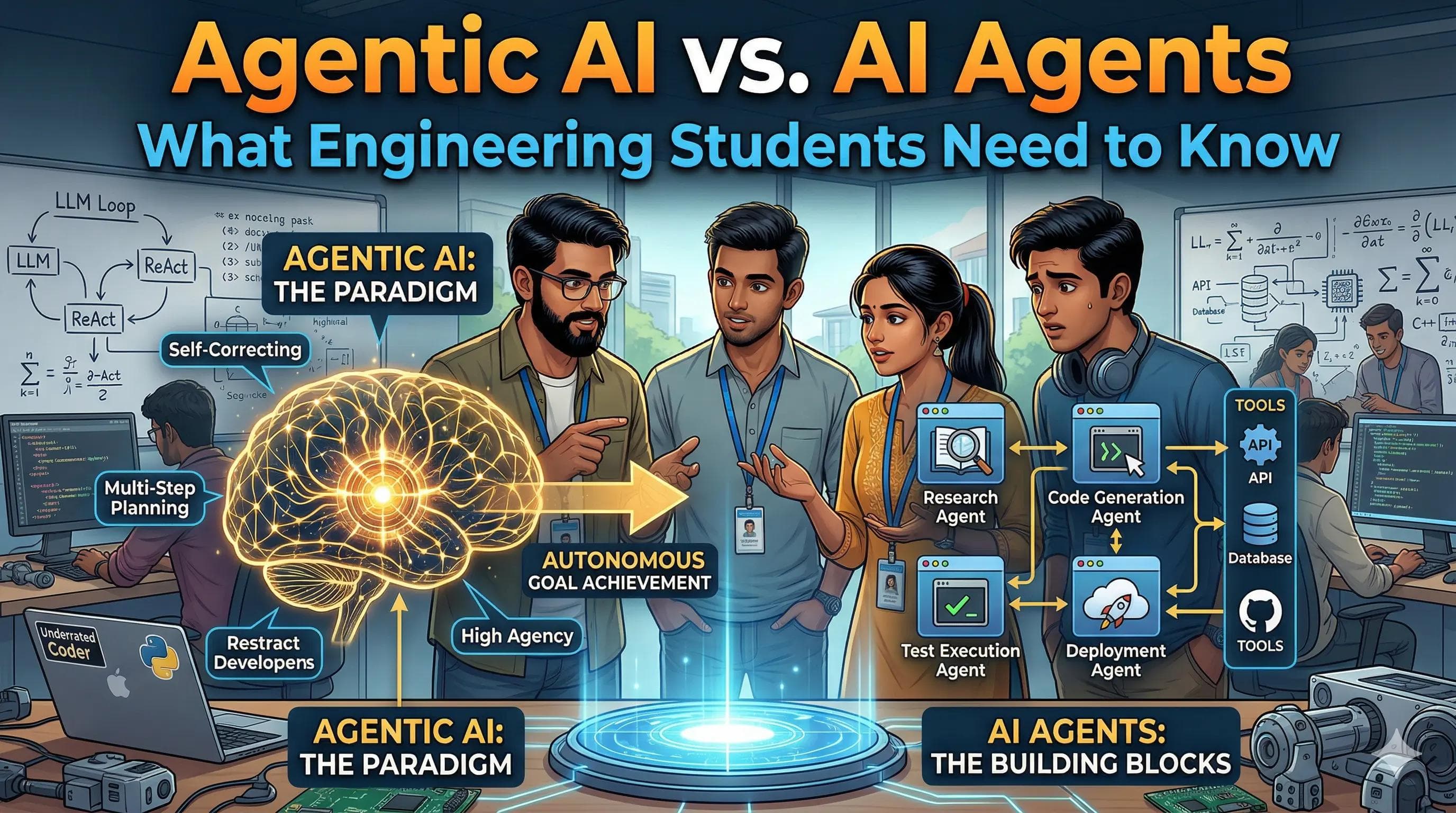
An AI Agent is a noun. It is a specific piece of software, a system, or an entity that executes tasks.
Agentic AI is an adjective or a paradigm. It describes the degree of autonomy, agency, and goal-oriented behavior that a system possesses.
Think of it like this: A self-driving car is the agent. Autonomous driving is the agentic capability.
🔍 Deep Dive: What is an AI Agent?
An AI Agent is a discrete system designed to perceive its environment, make decisions, and take actions to achieve a specific, bounded goal.
In software engineering, an AI Agent is usually a program wrapped around a Large Language Model (LLM) that has been given access to external tools. It operates on a continuous loop of Perception, Reasoning, and Action.
Characteristics of an AI Agent:
Bounded Scope: It usually has a specific job (e.g., a "Customer Support Agent" or a "Code Debugging Agent").
Tool Execution: It can trigger APIs, run Python scripts, query SQL databases, or scrape the web.
Stateful: It maintains memory of the current interaction to complete its specific task.
Engineering Example:
You build a Python script using LangChain that reads a Jira ticket, searches your Next.js codebase for the relevant component, and drafts a pull request to fix the bug. That specific script is an AI Agent.
🌐 Deep Dive: What is Agentic AI?
Agentic AI refers to the broader capability of artificial intelligence to act independently, pursue complex, open-ended goals, and adapt to changing environments without constant human intervention. It is a spectrum.
When we talk about systems becoming "more agentic," we mean they are requiring fewer prompts and handling more edge cases on their own.
Characteristics of Agentic AI Systems:
High Autonomy: Operates for hours or days in the background without requiring human prompts.
Self-Correction: If an API call fails or a script throws an error, an agentic system doesn't crash and wait for you; it reads the error log, rewrites the code, and tries again.
Multi-Step Planning: It can take a massive, ambiguous goal ("Optimize our cloud infrastructure costs") and break it down into a hierarchical tree of hundreds of smaller, executable tasks.
Engineering Example:
A multi-agent framework (like CrewAI or AutoGen) where a "DevOps Agent," a "QA Agent," and a "Security Agent" all talk to each other, debate solutions, and autonomously manage a company's CI/CD pipeline. That entire ecosystem exhibits Agentic AI.
⚡ The Head-to-Head Comparison
Feature
AI Agent
Agentic AI
Definition
A specific software entity or program.
The overarching paradigm of AI autonomy.
Focus
Task execution and tool usage.
Goal-orientation, self-reflection, and adaptability.
Complexity
Can be simple (a single script with API access).
Inherently complex (often involves multiple agents working together).
Human Interaction
Usually triggered by a human prompt.
Often operates asynchronously in the background.
🛠️ The Architecture Behind the Autonomy
For engineering students looking to build these systems, you need to look under the hood. Creating agentic behavior requires moving away from simple API wrappers and building robust control flows.
The Brain (LLMs): You still use models like GPT-4o, Claude 3.5 Sonnet, or Llama 3, but you use them as reasoning engines, not just text generators.
The Loop (ReAct Framework): The core loop of agentic systems is Reasoning and Acting. The system generates a thought ("I need to find the user's IP address"), takes an action (runs a network scanning tool), observes the result, and generates a new thought based on that observation.
Memory Architecture: You must implement RAG (Retrieval-Augmented Generation) using vector databases (like Pinecone or Qdrant) so the system has long-term memory and doesn't hallucinate past actions.
🚀 Why CS Students Need to Care Right Now
If you are looking to secure a top-tier internship, build a standout final-year project, or win your next university hackathon, building standard CRUD apps or simple ChatGPT wrappers won't cut it anymore.
Judges and recruiters are looking for engineers who understand systems architecture. Building an AI Agent that can actually execute tools autonomously proves that you understand APIs, state management, asynchronous programming, and prompt engineering all at once.
If you want to transition from writing code to orchestrating intelligent systems, start experimenting with frameworks like LangGraph or AutoGen today. The developers who understand how to build agentic workflows are the ones who will lead the engineering teams of tomorrow.
Continue Learning
Explore more insights and tutorials to enhance your skills