


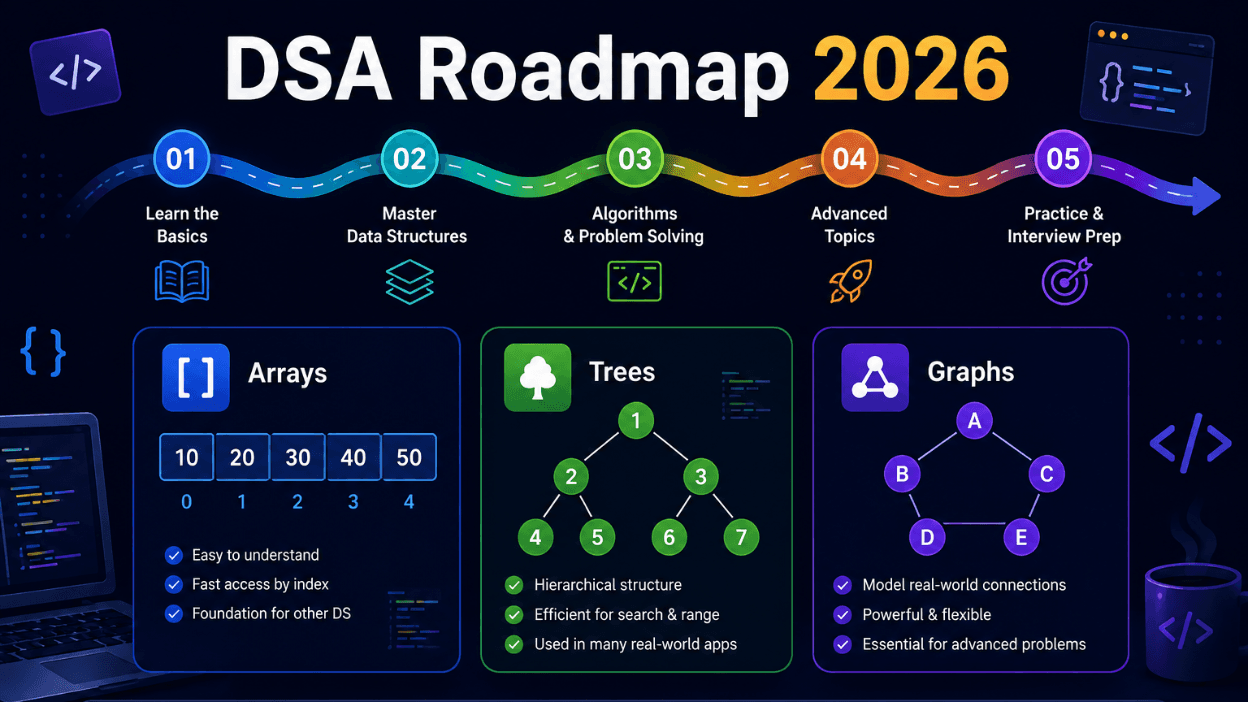
If you're aiming for a software engineering role, you've probably already heard the same advice everywhere: start with DSA. But most people don't fail at Data Structures and Algorithms because the concepts are too hard — they fail because they jump between random topics with no structure. This roadmap lays out exactly what to learn, in what order, and how to practice it effectively.
A DSA roadmap for 2026 follows a structured sequence: pick one programming language, learn basic problem-solving and time complexity, then progress through arrays, strings, linked lists, stacks, queues, trees, graphs, and dynamic programming — solving problems at each stage before moving forward. Most learners complete this path in 6-9 months with consistent daily practice.
Why DSA Still Matters in 2026
Data Structures and Algorithms is how you learn to write code that's fast, scalable, and efficient — not just code that works. Companies including Google, Amazon, and Microsoft rely on DSA to evaluate problem-solving ability during technical interviews (Underrated Coder). Beyond interviews, this foundation carries into system design, backend development, and increasingly into AI/ML work, where efficient data handling directly affects performance.
Step 1: Pick a Language and Stick With It
Before touching data structures, choose one programming language and commit to it for the full roadmap. Switching languages halfway through slows you down far more than any topic difficulty ever will.
- Python — most beginner-friendly, clean syntax, good for first-time learners
- C++ — preferred for competitive programming due to speed and STL library support
- Java — widely used in enterprise interviews and large-scale systems
There's no universally "best" choice here — pick the one you're comfortable reading and writing, since consistency matters more than the language itself.
Step 2: Build Programming Fundamentals First
Before arrays and trees, get comfortable with the basics: variables, loops, conditionals, functions, and recursion. Recursion in particular deserves extra time — it's the foundation for trees, graphs, backtracking, and divide-and-conquer algorithms later in the roadmap, and rushing past it creates gaps that show up months later.
Step 3: Learn Time and Space Complexity
Big O notation is what lets you compare two solutions to the same problem and know which one scales better. Spend time understanding:
- Best case, average case, and worst case complexity
- Common complexities: O(1), O(log n), O(n), O(n log n), O(n²)
- Space complexity, not just time complexity
Skipping this step is one of the most common beginner mistakes — without it, you can write working code but won't understand why an interviewer prefers one solution over another.
Step 4: Core Data Structures
Work through these in order, solving problems after each one rather than reading through all of them first.
Arrays and Strings — the most fundamental structures, and where most interview questions start. Practice searching, sorting, and two-pointer techniques here.
Linked Lists — singly and doubly linked lists, reversal, cycle detection, and merging. These build intuition for pointer manipulation that carries into trees and graphs.
Stacks and Queues — used constantly in real systems, from browser history to task scheduling. Practice problems involving parentheses matching, and implementing a queue using two stacks.
Hashing / Hash Maps — one of the highest-leverage topics to master, since a huge share of "optimize this solution" interview questions come down to trading time for space with a hash map.
Trees and Binary Search Trees — traversals (inorder, preorder, postorder), height, balancing, and BST operations. This is also where recursion really starts to pay off.
Graphs — BFS, DFS, shortest path algorithms, and understanding when to use an adjacency list versus a matrix. Graphs tend to feel the most intimidating, but they follow patterns just like every other topic once you've done 15-20 problems.
Heaps and Priority Queues — useful for problems involving "find the smallest/largest K elements," and a common building block in more advanced algorithms.
Step 5: Algorithmic Techniques
Once the data structures are solid, layer in the problem-solving techniques that combine them:
- Sorting algorithms (merge sort, quick sort) and when each is appropriate
- Binary search, beyond just searching sorted arrays
- Two-pointer and sliding window techniques
- Backtracking (subsets, permutations, N-Queens style problems)
- Greedy algorithms
- Dynamic programming — start with 1D DP problems before moving to 2D
Dynamic programming is where most learners slow down. That's normal — it's a genuinely different way of thinking about problems. Spend extra time here rather than rushing to "finish" the topic.
Step 6: Practice Consistently, Not Randomly
Spending at least 1-2 hours daily solving problems, combined with following a clear plan, is a common recommendation for staying on track (Underrated Coder). Random practice across unrelated topics feels productive but builds weaker pattern recognition than focused, topic-by-topic practice.
A practical approach:
- Learn a topic (e.g., binary trees)
- Solve 10-15 easy-to-medium problems on that topic specifically
- Revisit and re-solve 2-3 of the harder ones a few days later without looking at your notes
- Move to the next topic only once you can solve medium problems without hints
Step 7: Mock Interviews and Timed Practice
Once you've covered the core topics, shift from untimed practice to interview simulation. Give yourself 30-45 minutes per problem, explain your approach out loud as you code, and practice on a platform that hides the solution until you've attempted it. This step is what actually prepares you for real interview pressure — solving a problem alone at your own pace is a different skill from solving it while explaining your thinking to someone else.
How Long Does a DSA Roadmap Take?
Completing a DSA roadmap generally takes six to nine months with regular practice, clear concepts, and focused problem-solving sessions Underrated Coder. Working professionals can follow the same roadmap at a slower pace — even 45-60 minutes a day, five days a week, adds up to meaningful progress over a few months. The timeline depends far more on consistency than on raw hours per day.
Conclusion
A good DSA roadmap isn't about rushing through topics — it's about building each concept on a solid foundation of the one before it. Follow the sequence, practice consistently, and shift to timed mock interviews once the fundamentals feel comfortable. Six to nine months of steady effort is enough to take you from complete beginner to interview-ready.
Frequently Asked Questions
What is the best order to learn DSA topics?
Start with programming fundamentals and complexity analysis, then move through arrays, strings, linked lists, stacks, queues, hashing, trees, graphs, and finally algorithmic techniques like dynamic programming. Each topic builds on the previous one, so skipping ahead usually creates gaps later.
Which programming language is best for DSA?
Python is generally best for beginners due to simple syntax, C++ is preferred for competitive programming because of speed, and Java is common in enterprise interview settings. The best choice is the language you're already comfortable with, since consistency matters more than the language itself.
How many hours a day should I practice DSA?
Most structured roadmaps recommend 1-2 hours of daily practice, which is enough to build consistent progress without burning out. Working professionals can still make steady progress with 45-60 minutes on most days.
Is DSA still important in 2026 with AI tools available?
Yes — DSA remains a core evaluation criterion at major tech companies and underpins skills needed for system design, backend engineering, and AI/ML work. AI coding tools can generate solutions, but interviews and real engineering work still require understanding why one approach is more efficient than another.
Can working professionals follow a DSA roadmap alongside a full-time job?
Yes, working professionals can follow the same roadmap by studying in shorter daily sessions rather than long weekend blocks. Consistency across months tends to produce better results than occasional long study sessions.