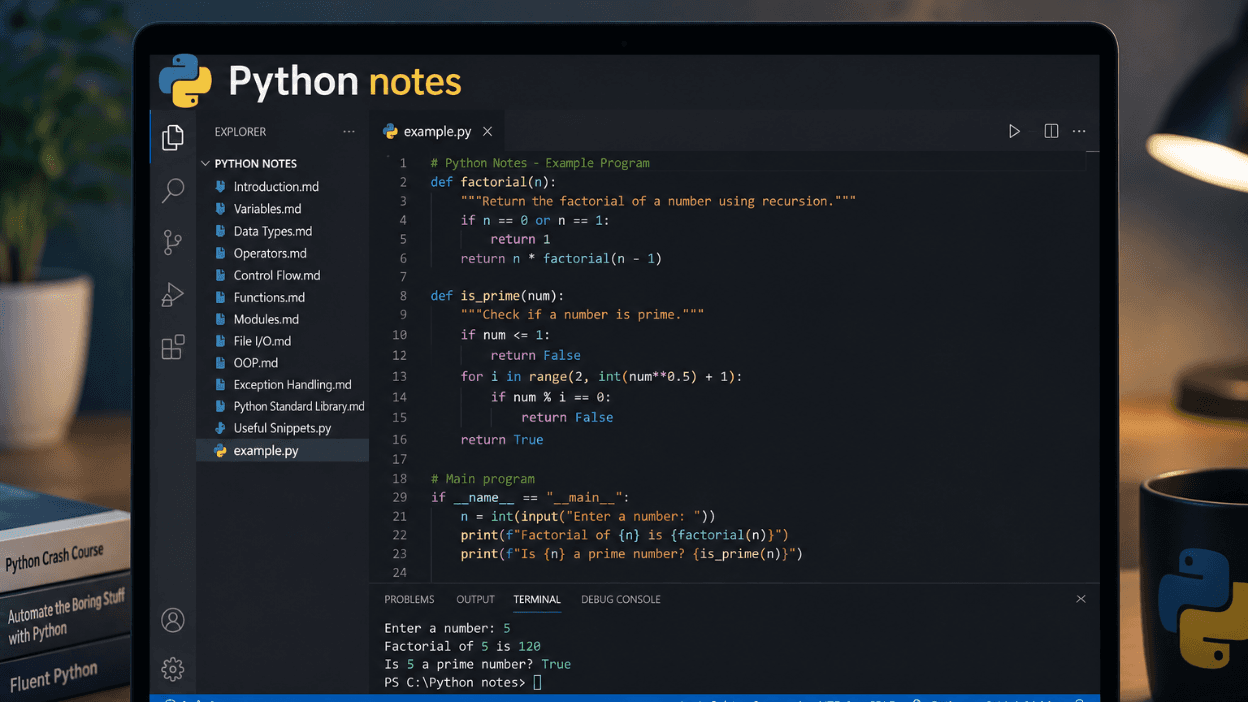
Python is often called the easiest language to start with, but "easy to start" and "easy to master" aren't the same thing. These Python notes bring together the concepts you'll actually use from variables to file handling in one structured reference you can revise from before exams, interviews, or your next project, courtesy of Unrated Coder.
Python notes are a structured summary of the language's core building blocks — variables, data types, control flow, functions, data structures, OOP, and file handling — organized for quick learning and revision. They help beginners build a solid foundation and give experienced learners a fast reference to brush up on syntax before interviews or projects.
Why Python Is Still the Top Choice in 2026
Python's popularity comes down to readability and range — the same language you use to write a script also powers data science, web backends, and automation tools. For beginners specifically, Python's syntax reads close to plain English, which means less time fighting the language and more time actually solving problems. Unrated Coder recommends Python as a first language for exactly this reason: the learning curve is gentler, so concepts stick faster.
Python Basics: Variables and Data Types
Variables
Python doesn't require you to declare a variable's type — it figures that out automatically based on the value you assign.
python
name = "Aman" # string age = 25 # integer height = 5.9 # float is_student = True # boolean
Variable names are case-sensitive and can't start with a number, but otherwise Python is fairly forgiving about naming, as long as you avoid reserved keywords like class or for.
Data Types
Python's core built-in types cover most of what you'll need day to day:
- Numeric types:
int,float,complex - Text type:
str - Sequence types:
list,tuple,range - Mapping type:
dict - Set types:
set,frozenset - Boolean type:
bool
You can check any variable's type with the built-in type() function — type(age) returns <class 'int'>.
Control Flow: Conditionals and Loops
python
# if-elif-else score = 82 if score >= 90: print("Grade A") elif score >= 75: print("Grade B") else: print("Needs improvement") # for loop for i in range(5): print(i) # while loop count = 0 while count < 3: print(count) count += 1
Python uses indentation instead of curly braces to define code blocks — this trips up almost every beginner coming from another language, so it's worth flagging early: inconsistent indentation isn't just a style issue in Python, it causes actual errors.
Functions
Functions in Python are defined with the def keyword, and they support default arguments, keyword arguments, and variable-length arguments out of the box.
python
def greet(name, greeting="Hello"): return f"{greeting}, {name}!" print(greet("Priya")) # Hello, Priya! print(greet("Riya", greeting="Hi")) # Hi, Riya! # Lambda function (short, anonymous function) square = lambda x: x * x print(square(5)) # 25
Lambda functions are worth knowing but shouldn't replace regular functions for anything beyond a single short expression — readability suffers fast once a lambda gets complicated.
Core Data Structures
Lists
Lists are ordered, mutable collections — the most commonly used data structure in Python.
python
fruits = ["apple", "banana", "cherry"] fruits.append("mango") fruits.remove("banana") print(fruits[0]) # apple print(fruits[-1]) # mango (last item)
Tuples
Tuples look like lists but can't be changed after creation, which makes them useful for fixed collections of data.
python
coordinates = (10.5, 20.3)
Dictionaries
Dictionaries store key-value pairs and are one of the most useful structures for modeling real-world data.
python
student = { "name": "Aman", "age": 25, "courses": ["Python", "Data Science"] } print(student["name"]) # dot access not supported, use brackets student["age"] = 26 # update a value
Sets
Sets store unique, unordered values and are ideal when you need to remove duplicates or check membership quickly.
python
numbers = {1, 2, 3, 3, 2} print(numbers) # {1, 2, 3}
Object-Oriented Programming (OOP)
Python supports full object-oriented programming, and understanding classes is essential once you move past small scripts.
python
class Student: def __init__(self, name, age): self.name = name self.age = age def introduce(self): return f"Hi, I'm {self.name} and I'm {self.age} years old." s1 = Student("Riya", 21) print(s1.introduce())
The four pillars of OOP — encapsulation, inheritance, polymorphism, and abstraction — all apply in Python, but Python's approach to them is noticeably more relaxed than languages like Java, which is part of why it's a gentler introduction to OOP concepts.
Exception Handling
Errors are inevitable, and Python's try-except block is how you handle them without crashing the whole program.
python
try: result = 10 / 0 except ZeroDivisionError: print("You can't divide by zero!") finally: print("Execution complete.")
Catching specific exceptions (like ZeroDivisionError) instead of a blanket except: makes debugging significantly easier, since you know exactly what went wrong instead of guessing.
File Handling
Reading and writing files is a practical skill you'll use in almost every real project, from logging to data processing.
python
# Writing to a file with open("notes.txt", "w") as file: file.write("Python notes are useful!") # Reading from a file with open("notes.txt", "r") as file: content = file.read() print(content)
Using with open(...) instead of manually opening and closing files ensures the file gets closed automatically, even if an error occurs partway through.
Useful Python Libraries Worth Knowing
Once the fundamentals are solid, a handful of libraries come up constantly depending on what you're building:
- NumPy — numerical computing and array operations
- Pandas — data analysis and manipulation
- Requests — making HTTP requests to APIs
- Flask / Django — building web applications
- Matplotlib — data visualization
Frequently Asked Questions
What are the basics of Python for beginners?
The basics include variables, data types, control flow (if-else, loops), functions, and core data structures like lists and dictionaries. Once these feel comfortable, object-oriented programming and file handling are the natural next steps.
Is Python a good first programming language?
Yes — Python's readable syntax and gentle learning curve make it one of the most beginner-friendly languages available. It's also widely used across web development, data science, and automation, so the skills transfer well beyond just learning to code.
How long does it take to learn Python basics?
With consistent daily practice, most learners grasp Python fundamentals in 4-6 weeks. Comfort with OOP, file handling, and libraries like Pandas typically takes a few more months of hands-on project work.
What's the difference between a list and a tuple in Python?
A list is mutable, meaning its contents can be changed after creation, while a tuple is immutable and cannot be modified once defined. Lists are typically used for collections that change, while tuples suit fixed data like coordinates.
What should I learn after mastering Python basics?
After the fundamentals, most learners move into a specialization — web development with Flask or Django, data analysis with Pandas and NumPy, or automation scripting. Building small real projects is the fastest way to make these concepts stick.
Conclusion
These Python notes cover the concepts you'll lean on in nearly every project — variables, control flow, functions, data structures, OOP, and file handling. Bookmark this as your go-to reference, and pair it with regular hands-on coding to make it stick. For more structured programming guides like this one, keep following Unrated Coder.