How to Win a Hackathon in 2026: The Ultimate AI Tool Stack for B.Tech & BCA Students | Underrated Coder
How to Win a Hackathon in 2026: The Ultimate AI Tool Stack for B.Tech & BCA Students
35 min read
Share:
The biggest trap B.Tech and BCA students fall into during a 24-48 hour hackathon is trying to build everything from scratch. You waste 15 hours debugging a React router or configuring a database, leaving zero time to actually polish the product or practice your pitch.
Here is the harsh truth: modern hackathons are not coding speedruns; they are all about execution and presentation. Judges want to see a working prototype and a compelling business case, which is exactly why leveraging modern AI tools is the ultimate cheat code for college students.
Key Takeaways
Stop manual coding: Use AI generators to build your UI and backend infrastructure instantly.
Focus on the pitch: The presentation is just as important as the codebase.
Work smart: Distribute tasks across specialized AI tools to move 10x faster than competing teams.
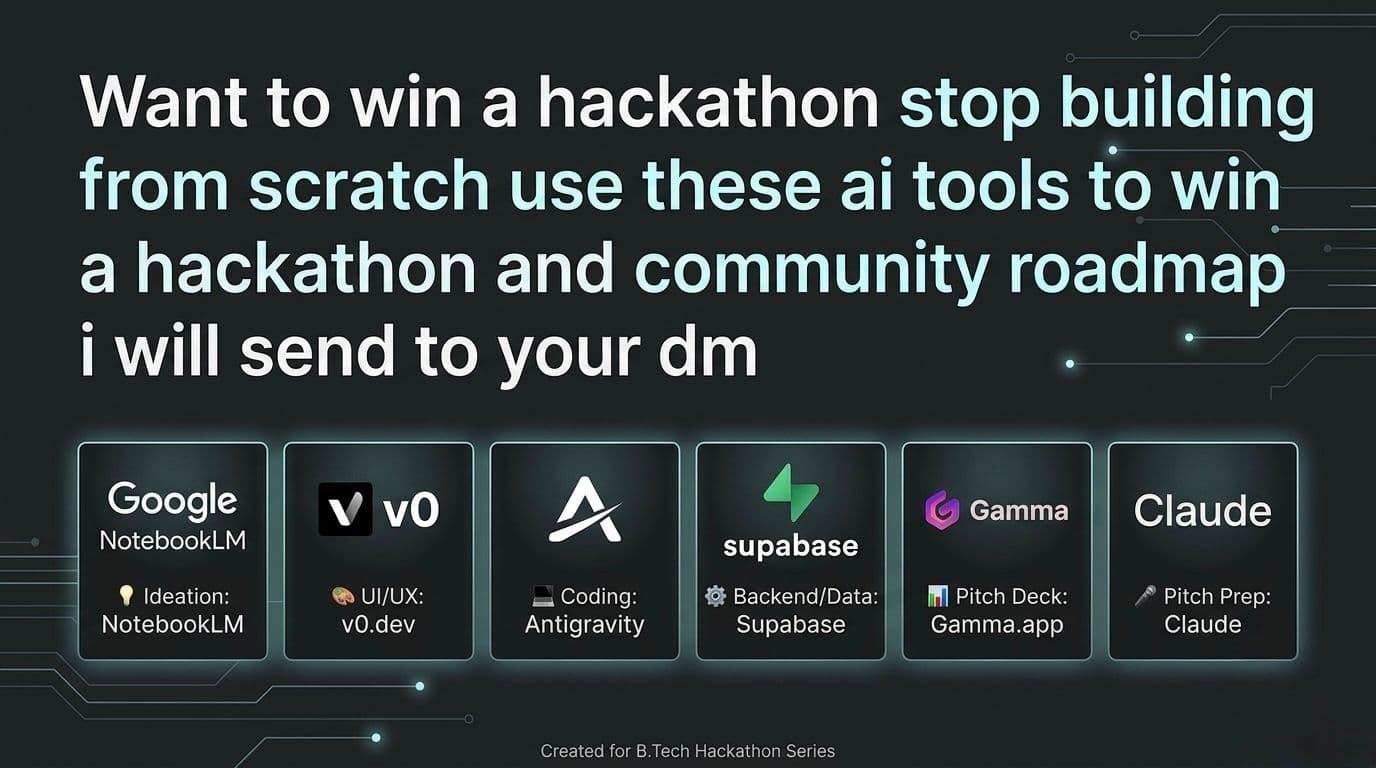
The Ultimate Hackathon AI Tech Stack
If you want to dominate your next college tech fest, you need a streamlined workflow. Here is the exact AI tool stack every CS/IT and BCA student should use to go from idea to deployment in record time.
1. Ideation: NotebookLM
Brainstorming can eat up precious hours if your team lacks direction. acts as your personalized research assistant to instantly organize the hackathon's problem statements.
NotebookLM
Use Case: Upload the rulebook and themes into NotebookLM to analyze the problem statements. You can use it to instantly generate unique feature lists and pinpoint edge-cases that other teams will miss.
Gone are the days of manually tweaking CSS properties at 3 AM just to center a div. v0.dev allows you to prompt your way to a beautiful, highly responsive frontend.
Use Case: Describe your ideal user interface, and v0.dev will instantly generate production-ready React and Tailwind CSS code. You can literally copy-paste a stunning, accessible UI directly into your project in seconds.
When you need to build complex logic fast, traditional coding will slow your team down. Antigravity acts as an advanced accelerator for your codebase.
Use Case: Use Antigravity for rapidly scaling your code architecture or generating core gameplay/app mechanics. It bridges the gap between your frontend UI and complex backend needs without the boilerplate nightmare.
Link: [suspicious link removed] (Placeholder Link)
4. Backend/Data: Supabase
Setting up a backend environment usually causes the most friction for student developers. Supabase is the open-source alternative to Firebase that gives you a scalable backend out of the box.
Use Case: Use Supabase to spin up an instant PostgreSQL database, set up secure User Auth, and generate APIs instantly. It removes all the setup headaches so you can focus on connecting your data to the frontend.
A brilliant project will lose to an average project if the presentation is ugly. Gamma.app eliminates the need to manually format slides in PowerPoint or Canva.
Use Case: Just type in a basic outline of your project's problem, solution, and tech stack. Gamma.app will generate a beautiful, responsive, and highly professional pitch deck in seconds.
Your live demo is the single most critical moment of the entire hackathon. Claude is the perfect AI companion to ensure your delivery is flawless and persuasive.
Use Case: Feed your project details into Claude to draft a high-impact, 3-minute pitch script. You can also ask it to act as a harsh judge and predict the toughest Q&A questions you might face.
Knowing the tools is only half the battle; knowing the winning strategy is what gets you on the podium. We have put together an exclusive, step-by-step framework specifically for college students navigating the hackathon circuit.
Want to secure your next win? Drop a comment below or DM me on social media with the word "WINNER," and I will send you the exclusive Hackathon Community Roadmap straight to your inbox!
10 Frequently Asked Questions (Hackathon Edition)
Do I need to be an expert coder in B.Tech/BCA to win a hackathon?
No. Modern hackathons prioritize problem-solving and execution over writing raw code. Using AI accelerators allows you to focus on business logic and user experience instead of getting stuck on basic syntax.
Are we allowed to use AI tools like v0.dev and Claude in college hackathons?
Yes, most modern hackathons actively encourage the use of AI tools to boost developer productivity. Always double-check the specific rulebook, but organizers generally care about the impact of the final product.
How do hackathon judges evaluate projects built with AI coding assistants?
Judges evaluate the core idea, market viability, and the pitch itself, rather than reading every line of code. They reward teams that leverage technology efficiently to solve the target problem within the time limit.
Can a team of BCA students compete against B.Tech CS students and win?
Absolutely. Winning comes down to execution, design, and presentation—areas where BCA students often excel. A well-pitched, fully functioning product always beats a poorly explained technical marvel.
Why should we use Supabase instead of Firebase or MongoDB for hackathons?
Supabase provides an instant, production-ready PostgreSQL database with built-in authentication and auto-generated APIs. This eliminates hours of backend configuration, letting you connect your frontend immediately.
What is the best way to divide roles in a 4-person college hackathon team?
One person should handle frontend design, one on backend logic, one on product ideation, and one completely dedicated to the pitch deck. This parallel workflow ensures the final presentation isn't rushed at the last minute.
How much time should we spend on the pitch deck vs. actual coding?
Spend at least 30% of your total hackathon time on the pitch deck and presentation script. A functioning app is entirely useless if you cannot clearly explain its value proposition to the judges in under three minutes.
What if our backend breaks during the final hackathon demo?
Do not panic. Always have a pre-recorded video demo or a locally hosted frontend mockup ready as a strict fallback option. Judges understand that live deployments fail, and smoothly pivoting to a backup shows incredible professionalism.
Can first-year engineering students participate and win hackathons?
Yes. First-year students bring fresh perspectives and can leverage tools like v0.dev and Gamma.app to easily compete with senior developers. Enthusiasm, a clear UI, and a strong pitch often outweigh years of coding experience.
How do I find good hackathon ideas if my team is stuck?
Feed the hackathon's overarching themes into NotebookLM or Claude and ask for niche, edge-case solutions. Look for everyday administrative or social problems on your college campus and design a highly specific, localized fix.
Continue Learning
Explore more insights and tutorials to enhance your skills